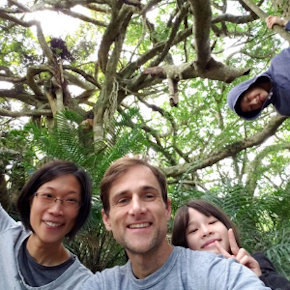
In early September, Camp Mondamin welcomed a group of young people from Taiwan who had traveled across the ocean to pursue a dream of learning and exploration in the United States.
For many of these young participants, it was their first time traveling so far from home and visiting the United States. Coming from a wide range of professional and academic backgrounds, all 18 participants had gone through a competitive selection process to receive funding from the Taiwanese government’s Taiwan Global Pathfinders Initiative.
These young people embarked on a journey centered on the theme of resilience. Over the course of their visit, they explored urban resilience in Asheville, NC and Greenville, SC during the two years following the devastation caused by Hurricane Helene in 2024. Camp Mondamin was honored to serve as a partner in this initiative. Through outdoor exploration and experiential education at the camp, they had opportunities to discover how personal and team resilience develop through challenges, while putting the sustainability principles of Leave No Trace into practice.
After completing the program, participants shared a variety of insights and reflections on their outdoor education experience at Camp Mondamin. Some observed that Taiwan actually has abundant natural resources, including magnificent mountains, forests, and coastlines. However, outdoor experiences are often fragmented, with individual activities taking place at separate locations. There are relatively few integrated outdoor education settings where young people can enjoy a diverse range of land- and water-based activities within one natural environment. They also noted that some outdoor education facilities in Taiwan tend to feature extensive concrete construction and elaborate artificial structures, sometimes at the expense of the surrounding natural ecosystem.
Others came to realize that outdoor education at Camp Mondamin can bring together adventure, safety education, teamwork, and environmental awareness. They described the camp as a well-designed outdoor classroom, where the key to delivering activities smoothly and safely lies in thorough preparation and clear, detailed instructions.
One participant was particularly impressed by the philosophy behind American outdoor leadership: respecting individual choices while providing a safe and supportive environment.
Before every activity, instructors provided comprehensive safety demonstrations and clearly explained the rules and guidelines. This allowed participants to challenge themselves and explore the unfamiliar while understanding how to keep themselves safe. With professional guidance and safety measures in place, they could build confidence without feeling pressured, gradually developing the courage and resilience to step outside their comfort zones.
The participant also noticed a difference between American and Taiwanese approaches to education. Children in the United States often grow up feeling comfortable taking on challenges such as swimming in open water or jumping into the water from heights. Even when children want to attempt more challenging movements, such as forward flips or backward jumps, lifeguards do not necessarily prohibit them outright. Instead, they may simply say, “You can try,” allowing children to assess the situation and make their own decisions within a safe environment. In contrast, parents and educators in Taiwan sometimes tend to discourage these attempts out of concern that children might get hurt, unintentionally taking away opportunities for them to experiment, learn from experience, and develop confidence in their own judgment. Another participant discovered a new way to connect outdoor education with academic learning through orienteering at Camp Mondamin. After returning to Taiwan, they hoped to incorporate orienteering activities into their mathematics curriculum. Since orienteering involves mathematical concepts such as map scales, ratios, and coordinates, it offers an opportunity to design campus-based navigation activities where students can apply mathematical knowledge in real-world situations.
These reflections remind us that outdoor education is about much more than adventure and recreation. It is an opportunity to cultivate independence, confidence, critical thinking, teamwork, and a deeper respect for the natural world.
At Camp Mondamin, we were grateful to be part of this cross-cultural learning journey. We hope these young people will carry their experiences back to Taiwan, inspire new possibilities in education, and continue building resilience in their own communities.
Co-written by David and his wife Yijun Wang